There is no need to stress! e-PayDay Go Award-centric payroll software ensures you effortlessly comply with Payday Super requirements and the Fair Work Voluntary Wage Compliance Code.
The History of e-PayDay and Australian Payroll Software Since 1986.
e-PayDay has been part of the Australian payroll software industry since 1986, when Allan Reed and Brett Reed established ANR Computer Services in Brisbane, Queensland. The business later evolved into LOGISOFT Australia, developing PayPacket™ and other Australian business software before its payroll products became known as e-PayDay®.
Over almost four decades, our payroll software has evolved from DOS-based payroll programs distributed on floppy disks to Windows payroll software, Single Touch Payroll (STP) reporting and today's cloud-based e-PayDay Go® payroll software.
Throughout that evolution, our focus has been on developing payroll software around the needs of Australian employers, Australian payroll compliance and award-based payroll processing. As payroll legislation, taxation, superannuation and workplace requirements have changed, our software has continued to evolve with them.
Today, that history is reflected in e-PayDay's compliance-first, award-centric approach to Australian payroll software, including support for Single Touch Payroll Phase 2, Payday Super and Fair Work Modern Awards.
This page documents the history of ANR Computer Services, LOGISOFT Australia and e-PayDay Pty Ltd, including the development of PayPacket™, the Logisoft Payroll Series™, e-PayDay®, FREEPAY® and e-PayDay Go®, together with significant company milestones, historical advertisements, industry recognition and our involvement in the development and implementation of Single Touch Payroll in Australia.

PayPacket™ was one of our earliest Australian payroll software products and formed part of the evolution from LOGISOFT Australia to e-PayDay®.
e-PayDay History: Key Facts
From our beginnings in Brisbane in 1986 to today's cloud-based e-PayDay Go®, our history reflects almost four decades of developing Australian payroll software around changing payroll, taxation, superannuation and workplace requirements.
These milestones show how e-PayDay has progressed from early Australian payroll programs to modern cloud payroll software while maintaining its focus on the requirements of Australian employers and Australian payroll compliance.
From ANR Computer Services to LOGISOFT Australia
The origins of e-PayDay can be traced back to the late 1950s, when Allan Reed operated ANR Electrics in South Brisbane, Queensland. The name ANR represented Allan and Nancy Reed.
On 22 April 1986, Allan Reed and his son, Brett Reed, established ANR Computer Services as a family business. Initially, the business assembled and sold IBM-compatible computers to home users and supplied computer peripherals and accessories to computer resellers.
ANR Computer Services first operated from Unit 4 at 26 Lima Street, Auchenflower, Queensland. As the business grew, it moved to Sherwood House at 39 Sherwood Road, Sherwood, and later to Benson House in Toowong, Queensland.
Alongside the computer hardware business, Allan recognised an opportunity to develop affordable Australian business software. Early software products included MS-DOS Tutorial™ and Your Personal Accounting Tutor!™, both designed and programmed by Allan Reed. ANR Computer Services also marketed TransView™, software that enabled programs designed for EGA graphics to operate using Hercules graphics hardware.
LOGISOFT Software Documented in 1989
By April 1989, LOGISOFT Australia's software products were receiving coverage in the Australian computer press.
In its April 1989 edition, Your Computer featured two LOGISOFT Australia products in its New Products section: TransView and Accounting Tutorial.
TransView was described as an Australian memory-resident utility that allowed users to run colour software on a Hercules or compatible monochrome computer system. The publication also featured LOGISOFT Australia's Accounting Tutorial, software designed to teach basic accounting principles to potential users of accounting software.
The contemporary report noted that Accounting Tutorial had been recommended by the Queensland Education Department and was being used by schools and colleges in Queensland.
This independent coverage provides a surviving record of LOGISOFT Australia's software development activities in 1989, before the company's later focus became increasingly centred on Australian payroll software.

Your Computer, April 1989, featuring LOGISOFT Australia's TransView and Accounting Tutorial software in its New Products section.
ANR Computer Services later began selling LOGI Computers, IBM-compatible computers manufactured by Logicraft Products Manufacturing Pte. Ltd. in Singapore. With the business now selling both computer hardware and software, a new identity was created to bring those activities together.
LOGISOFT Australia also distributed software developed by other companies. In 1988, the company was the Australian distributor of WENDIN-DOS, a multiuser and multitasking MS/PC-DOS replacement operating system. A surviving advertisement published in Australian Personal Computer in May 1988 records LOGISOFT Australia's operations at Suite 57, Benson House, 2 Benson Street, Toowong, Queensland.
LOGISOFT Australia was registered as a Queensland business on 14 October 1987, and the ANR Computer Services name ceased being used as the principal trading identity.
The name LOGISOFT was derived from “LOGIcal SOFTware” — reflecting the company's growing focus on developing practical software solutions for Australian businesses.
That evolution from a family computer business into an Australian software developer provided the foundation for what would become almost four decades of Australian payroll software development under LOGISOFT Australia and e-PayDay.
Developing Australian Payroll Software for Small Businesses.
In the late 1980s, we identified a need for Australian payroll software designed around the practical requirements of Australian employers. This led to the development of PayPacket™, one of LOGISOFT Australia's earliest payroll products. From the beginning, two principles were central to our approach: support the complexities of Australian award-based payroll processing and provide reasonably priced, cost-effective payroll software for small businesses.
This led to the development of PayPacket™, one of LOGISOFT Australia's earliest payroll software products designed for desktop computers using DOS. From the beginning, award-based payroll processing was an important part of the software's design, providing the flexibility needed to process employees working under different awards, pay rates, allowances, deductions and employment conditions.
At the same time, we wanted small businesses to have access to capable Australian payroll software without the cost of payroll systems designed primarily for larger organisations. This focus on affordable, cost-effective payroll software for small businesses became another important part of our product philosophy.
By March 1990, PayPacket™ was being promoted as payroll software “designed & produced entirely in Australia”, with pricing starting from $195. The software supported more than 50 user-defined Awards, more than 50 user-defined employee special pay rates, and more than 50 allowances and deductions that could be tailored to suit an Award.
PayPacket™ also provided automatic tax calculations using the standard computer tax coefficient tables from the Australian Taxation Office (ATO), reports, Group Certificates, and the ability to reverse a pay run.

PayPacket™ advertisement published in Your Computer, March 1990, showing support for more than 50 user-defined awards, special pay rates, allowances and deductions that could be tailored to suit an Award.
Australian Made from the Early Years
Australian development has been part of our identity since the earliest years of PayPacket™.
The Australian Made logo was introduced by the Australian Government in 1986, the same year development of PayPacket™ began. Designed by Australian graphic designer Ken Cato and officially launched by Prime Minister Bob Hawke, the distinctive green-and-gold kangaroo became a recognised symbol for products made in Australia.
PayPacket™ became the first payroll software licensed to carry the Australian Made logo, recognising that the software was developed and produced in Australia.

PayPacket™ was licensed to carry the Australian Made logo as Australian-developed payroll software.
That commitment to Australian-developed payroll software continues today with e-PayDay Go® and ClockMeIn®.
Experience PayPacket™ for DOS
A working historical version of PayPacket™ for DOS has been preserved online, allowing visitors to experience an early generation of our Australian payroll software designed for desktop computers directly in a modern web browser.
The preserved software provides a first-hand look at the PayPacket™ payroll interface and functionality developed by LOGISOFT Australia, providing an interactive connection to the early history of e-PayDay's payroll software.

PayPacket™ Version 6.04 for DOS, developed by LOGISOFT Australia. A working historical version of PayPacket™ can be explored in your web browser.
PayPacket™ Trial Software and Independent Review
By January 1992, LOGISOFT Australia was also using a trial software model that allowed businesses to evaluate PayPacket™ before purchasing the full product.
In its January 1992 edition, Your Computer reported that LOGISOFT Australia had released a PayPacket™ Trial Pack. For $39.95, users received a fully working version of PayPacket™ that could be used for up to 60 days of data or 10 pay runs, whichever came first.
The independent article also provides important evidence about the development of PayPacket™. Your Computer identified Allan and Brett Reed as the father-and-son team responsible for five years of development work behind PayPacket™ and reported that the software had been written using Compiled BASIC 7.
The reviewer described PayPacket™ as a fast and comprehensive payroll package, while also documenting functionality including Australian tax calculations, superannuation, direct bank transfers, payroll reports, leave accruals and Award structures.
This contemporary review provides independent evidence not only of PayPacket's functionality but also of the development work behind the software and of LOGISOFT Australia's early approach to enabling businesses to evaluate payroll software before purchasing it.


Your Computer, January 1992, reviewed the PayPacket™ Trial Pack and identified Allan and Brett Reed as the father-and-son team responsible for five years of development work behind PayPacket™.
Cost-Effective Payroll Software for Small Businesses
Our focus on making payroll software accessible to smaller employers continued as the product range developed.
Affordability remained an important part of LOGISOFT Australia's approach to payroll software. In October 1992, PayBook™ was being offered for $99.95 as an entry-level payroll system for small businesses with between 2 and 25 employees.
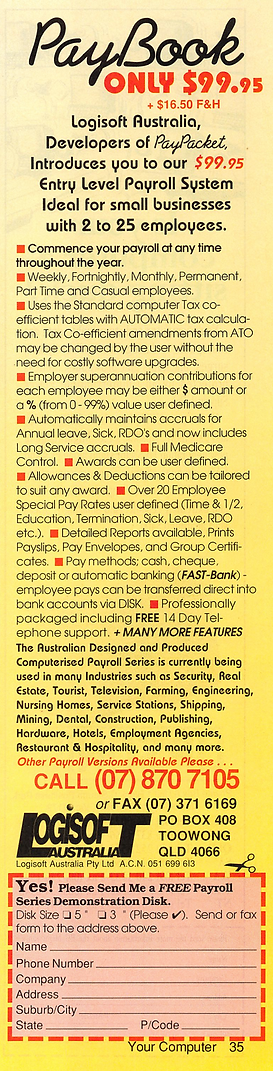
PayBook™ advertisement published in Your Computer, October 1992. The software supported Australian taxation, employer superannuation, leave accruals, user-defined awards, award-based allowances and deductions, and special pay rates.

Original PayBook™ retail box artwork. PayBook was developed by LOGISOFT Australia and distributed by Manaccom as an Australian small-business payroll product.
Despite its entry-level price, PayBook™ provided functionality covering Australian taxation, employer superannuation, Medicare, leave and award-based payroll processing. It supported automatic tax calculations and user-applied ATO tax coefficient amendments, employer superannuation contributions, and accruals for annual leave, sick leave, RDOs and long service leave.
Awards remained central to the software. PayBook™ provided user-defined awards, allowed allowances and deductions to be tailored to suit an Award, and supported more than 20 user-defined special pay rates.
This combination of award-based payroll functionality and cost-effective pricing for small businesses reflected the same principles that had guided the development of our payroll software from the beginning.
Introducing Tiered Payroll Software Pricing
LOGISOFT Australia's approach to affordable payroll software also included an early tiered pricing model based on the size and requirements of an employer's payroll.
A LOGISOFT Australia advertisement published in Your Computer in December 1992 shows three payroll software options at different employee capacities and price points:
PayBook™ was priced at $99.95 for small businesses with between 2 and 15 employees.
PayPacket™ was priced at $395.00 for a single company with up to 300 employees.
PayPacket PLUS™ was priced at $595.00 and supported multiple-company payrolls with up to 750 employees.

LOGISOFT Australia advertisement published in Your Computer, December 1992, showing PayBook™ for 2–15 employees, PayPacket™ for up to 300 employees and PayPacket PLUS™ for multiple-company payrolls of up to 750 employees.
Rather than requiring every employer to purchase the same payroll product, this structure allowed businesses to select software appropriate to the size and complexity of their payroll, with progressively more capable products available as their requirements increased.
This tiered approach formed part of LOGISOFT Australia's broader objective of providing reasonably priced Australian payroll software for small and growing businesses. The pricing model persisted across subsequent generations of LOGISOFT payroll software and can also be seen on the company's surviving 1997 website.
An Award-Centric Payroll Architecture
The importance of awards in our payroll software went far beyond providing a list of award-related features. Award-based payroll processing formed part of the underlying design of PayPacket™.
Independent evidence of this approach appeared in Your Computer magazine in March 1994, when reviewer Rob Williams examined seven payroll packages suitable for small businesses.
In his review of PayPacket™, Williams described its unique “award” structure as the “engine room” behind the software.
The award structure allowed combinations of hourly rates, annual leave, sick leave and RDO entitlements to be established. A separate pay rate table could then define an employee's rate as a percentage of the dollar amount established within the award.
The review described the flexibility of PayPacket's rate-and-award structure as “impressive”. It also documented the ability to establish rates on a per-unit basis, as a lump-sum commission or as a percentage of the award rate.

PayPacket™ Employee Awards screen featured in the independent Your Computer payroll software review, March 1994. The review described PayPacket's unique award structure as the “engine room” behind the software.
From Early Award Support to e-PayDay Today
These historical records demonstrate that award-based payroll processing was an important part of our payroll software from the beginning, with the underlying award architecture independently documented in 1994.
The technology and regulatory environment have changed enormously since PayPacket™ and PayBook™, but the principle of building Australian payroll software around Awards and the practical requirements of Australian employers has continued through successive generations of our software.
A significant development in that history occurred with the public deployment of e-PayDay Go® Version 0.1.0 (Beta) on 1 December 2022. The new cloud platform included support for the Fair Work Commission Modern Awards Pay Database (MAPD) API, bringing published Modern Award data directly into e-PayDay's award-centric payroll environment.
Through the MAPD API, e-PayDay Go® can work with Fair Work Commission data covering Awards, Classifications, Wage-Related Allowances, Expense-Related Allowances and Penalty Rates, providing a direct connection between the payroll software and current published Modern Award information.
This represents a technological evolution of an approach that can be traced back to PayPacket™: keeping Australian Awards and award-related payroll information close to the payroll process.
From PayPacket™ and PayBook™ to e-PayDay Go®, this history helps explain e-PayDay's continuing compliance-first, award-centric approach to Australian payroll software.
The Origins of Free Payroll Software and e-PayDay FREEPAY®
Our commitment to making payroll software reasonably priced and accessible to small businesses eventually led us to take the concept a step further — providing payroll software completely free for very small employers.
During the 1990s, LOGISOFT Australia introduced a free payroll software program for businesses with five or fewer employees. Distributed as freeware, it gave very small employers access to payroll software without having to purchase a commercial payroll software licence.
The concept was a natural extension of one of the principles that had guided our payroll software development from the beginning: small businesses should have access to capable Australian payroll software at a cost appropriate to the size of their workforce.
Rather than making the cost of software a barrier for Australia's smallest employers, the free product provided an entry point into the LOGISOFT payroll software range, with businesses able to move to larger versions as their number of employees increased.
From Freeware to e-PayDay FREEPAY®
As our payroll products evolved from the Logisoft Payroll Series™ to e-PayDay®, the free payroll software concept evolved with them.
The product eventually became known as e-PayDay FREEPAY®, with the FREEPAY® trademark registered on 5 August 2001.
By July 2003, the free payroll model was independently documented by PC User magazine. In its review of Logisoft e-PayDay 9, the magazine listed the price as free for up to five employees, with paid versions available for employers requiring larger payrolls.
The same article separately featured Logisoft e-PayDay Freepay in its “Try This Freebie” recommendation. PC User described Freepay as a fully functioning version of e-PayDay for payrolls of five employees or fewer and explained that businesses growing beyond the five-employee limit could move to another level of the product.
This provides independent historical evidence that e-PayDay was providing a genuine free payroll option for very small businesses more than two decades ago.

PC User, July 2003, reviewed Logisoft e-PayDay 9 and featured Logisoft e-PayDay Freepay as a fully functioning free payroll product for businesses with five employees or fewer.
FREEPAY® Today
The Australian payroll environment and the technology used to deliver payroll software have changed substantially since the original freeware product, but the principle behind FREEPAY® has continued.
Today, e-PayDay FREEPAY® provides free payroll software for Australian employers with up to three employees. There are no subscription fees, and eligible employers can use the software for their core payroll requirements, including Single Touch Payroll Phase 2, with unlimited STP lodgements.
FREEPAY® also reflects the broader evolution of e-PayDay's payroll software, with support for contemporary Australian payroll requirements including Payday Super, leave management, salary sacrifice and access to Fair Work Modern Award information.
What began as a way of making payroll software accessible to Australia's smallest employers has therefore continued across multiple generations of our products. FREEPAY® is not a recent addition to e-PayDay — it is the continuation of an approach to affordable and cost-effective payroll software that began decades ago.
e-PayDay and the Introduction of Single Touch Payroll in Australia
Single Touch Payroll represented one of the most significant changes to Australian payroll reporting since e-PayDay began developing payroll software in 1986.
STP introduced real-time digital payroll reporting, changing the way employers reported payroll information to the Australian Taxation Office. Instead of relying primarily on annual reporting, STP aligned reporting with the employer's normal payroll process, allowing salary and wages, PAYG withholding and superannuation information to be reported to the ATO each time employees were paid. The ATO continues to describe STP as the reporting of employee payroll information each time employees are paid, through STP-enabled software.
Rather than becoming involved only when payroll software developers were required to implement STP, e-PayDay participated in Australian Taxation Office Single Touch Payroll co-design and collaborative working groups during the development of the new reporting system.
This involvement provided an opportunity to contribute practical payroll software experience to discussions about how employers, payroll software developers and other participants would implement the new real-time reporting requirements.
Single Touch Payroll Co-Design and the STP Advisory Group
During 2015 and 2016, e-PayDay participated in ATO Single Touch Payroll co-design and collaborative working groups as the framework for STP was being developed.
e-PayDay subsequently became a member of the Single Touch Payroll Advisory Group, with Brett Reed representing e-PayDay.
The ATO states that the Single Touch Payroll Advisory Group was formed to help design and implement the Single Touch Payroll initiative through the collective knowledge, experience and influence of its members. The group brought together representatives from industry organisations, tax professionals and digital service providers to help shape the design and implementation of STP.
The ATO's historical membership record specifically identifies Brett Reed — e-PayDay as a member of the group. Its published consultation record shows meetings commencing on 26 July 2016 and continuing through subsequent years.
This provides an independent ATO record of e-PayDay's involvement in the design and implementation of Single Touch Payroll, rather than e-PayDay becoming involved only after STP had been designed.
Contributing to STP Technical Documentation
Brett Reed's involvement in Single Touch Payroll also extended to the technical implementation and documentation used by payroll software developers to build STP-enabled products.
Following the broader STP co-design and advisory work, Brett participated in ATO Single Touch Payroll technical groups concerned with the practical implementation of the new reporting framework.
In August 2017, an ATO membership record for the STP Document Navigation Guide Technical Focus Group identified Brett Reed of e-PayDay as one of the Digital Service Provider representatives participating in the group. The focus group worked within the ATO's STP Technical Committee environment.
Brett's technical involvement continued as Single Touch Payroll developed. An ATO membership record from January 2019 also identifies Brett Reed — e-PayDay Pty Ltd as a member of an STP Technical Committee technical focus group, representing the Payroll – Cloud / Desktop software segment.
This technical work included involvement with the documentation and implementation requirements supporting Payroll Event (PAYEVNT) — the ATO web service through which employers and their intermediaries meet their Single Touch Payroll reporting obligations. The PAYEVNT technical artefacts form part of the Australian Government's Standard Business Reporting framework.
Brett's involvement continued through the evolution of STP Phase 1 and STP Phase 2, contributing payroll software experience to the technical discussions, documentation and implementation requirements used by Digital Service Providers to support STP reporting.
The First Single Touch Payroll Report Processed by the ATO
A significant milestone occurred on 6 July 2017, when e-PayDay lodged the first Single Touch Payroll report processed by the Australian Taxation Office.
The historical e-PayDay transaction record below shows the STP Pay Event being sent on 6 July 2017, providing a contemporaneous software record of the lodgement.

e-PayDay Single Touch Payroll transaction record showing the STP Pay Event sent on 6 July 2017. e-PayDay lodged the first Single Touch Payroll report processed by the Australian Taxation Office.
The report was submitted using the PAYEVNT.0002.2017 specification through the ATO's Standard Business Reporting (SBR2) infrastructure, using an API provided by OZEDI as a Sending Service Provider (SSP).
The ATO's historical technical documentation confirms PAYEVNT.0002 (2017) as an early Payroll Event service used for Single Touch Payroll.
This represented an important milestone in the implementation of Single Touch Payroll and real-time payroll reporting in Australia, following e-PayDay's earlier involvement in the ATO's STP co-design and advisory processes.
It also marked another major step in e-PayDay's technological evolution — from Australian payroll software originally distributed on floppy disks in the 1980s to software capable of transmitting payroll information electronically through the ATO's Electronic Commerce Interface (ECI) to the Standard Business Reporting (SBR) infrastructure.
From STP Phase 1 to STP Phase 2
Following the initial implementation of Single Touch Payroll, e-PayDay continued to adapt its payroll software as STP requirements evolved.
e-PayDay Business Edition Version 17 was released on 26 June 2017 to support the ATO's Single Touch Payroll Phase 1 requirements.
A limited release of Single Touch Payroll commenced on 1 July 2017 for a small number of digital service providers and their clients. The ATO's July 2017 software industry update confirms that this limited release operated with a small group between July and October 2017.
STP subsequently became mandatory for employers with 20 or more employees from 1 July 2018 and was extended to employers with 19 or fewer employees from 1 July 2019, subject to applicable concessions and exemptions.
Single Touch Payroll subsequently evolved into STP Phase 2, expanding the information reported through payroll software and introducing additional reporting requirements and classifications.
The development of e-PayDay Go® continued this progression, moving e-PayDay from its Windows-based payroll software to a native cloud payroll platform designed for the contemporary Australian payroll and STP Phase 2 environment.
e-PayDay Go® Version 0.1.0 (Beta) was publicly deployed on 1 December 2022. In addition to supporting the STP Phase 2 environment, the new platform incorporated support for the Fair Work Commission Modern Awards Pay Database (MAPD) API, bringing published Modern Award information into e-PayDay's cloud payroll environment.
e-PayDay Go® Version 1 followed on 17 October 2023.
From participating in the original ATO co-design process and the Single Touch Payroll Advisory Group to lodging the first STP report processed by the ATO and subsequently supporting STP Phase 2, Single Touch Payroll has become an important part of e-PayDay's history and its compliance-first approach to Australian payroll software.
Australian Payroll Software Timeline: 1986 to Today
From the development of PayPacket™ in 1986 to today's e-PayDay Go® cloud payroll software, e-PayDay's history spans almost four decades of change in Australian payroll technology, taxation, superannuation, workplace requirements and payroll reporting.
The timeline below highlights significant milestones in the development of LOGISOFT Australia and e-PayDay, including the progression from DOS and Windows payroll software to electronic ATO reporting, Single Touch Payroll, STP Phase 2 and cloud payroll software.
e-PayDay Today: Australian Cloud Payroll Software
From the development of PayPacket™ in 1986 to e-PayDay Go® today, e-PayDay's payroll software has evolved alongside major changes in Australian taxation, superannuation, workplace legislation, payroll technology and government reporting requirements.
Today, e-PayDay develops Australian cloud payroll software around principles that can be traced through almost four decades of our history: understanding Australian payroll requirements, supporting award-based payroll processing, responding to changes in payroll compliance and making capable payroll software accessible to Australian businesses.
From Desktop Payroll Software to e-PayDay Go®
The public deployment of e-PayDay Go® Version 0.1.0 (Beta) on 1 December 2022 marked another major technological transition for e-PayDay.
After decades of DOS and Microsoft Windows payroll software, e-PayDay Go® became our native cloud payroll platform, designed for the contemporary Australian payroll environment and Single Touch Payroll Phase 2.
The first Beta release also incorporated support for the Fair Work Commission Modern Awards Pay Database (MAPD) API, bringing published Modern Award information into e-PayDay's award-centric payroll environment.
e-PayDay Go® Version 1 followed on 17 October 2023, establishing the foundation for the current generation of e-PayDay payroll software.

e-PayDay Go® is the current generation of e-PayDay's Australian payroll software, continuing a development history that began with PayPacket™ in 1986.
Continuing an Award-Centric Approach to Australian Payroll
Award-based payroll processing is not a recent addition to e-PayDay. Historical PayPacket™ documentation and independent reviews demonstrate that Awards formed part of the underlying payroll architecture of our software decades before e-PayDay Go® was developed.
The Fair Work Commission MAPD API represents the modern evolution of that approach.
Through the MAPD API, e-PayDay Go® can access published Fair Work Commission data for Modern Awards, Classifications, Wage-Related Allowances, Expense-Related Allowances and Penalty Rates. The integration also supports e-PayDay's Update Awards functionality, helping employers update Award-related payroll information when Fair Work Commission rates change.
This does not mean that e-PayDay automatically determines which Award or classification applies to an employee. Rather, the integration brings current Fair Work Commission Modern Award data closer to the payroll process once the appropriate Award and classification have been determined.
The technology is very different from the award structures built into PayPacket™ in the early years, but the underlying principle remains recognisable: Australian payroll software should be designed around the realities of Australian Awards and payroll processing.
A Compliance-First Approach to Australian Payroll
Australian payroll compliance has also become considerably more complex since our earliest payroll products.
Over time, e-PayDay has evolved to accommodate changes in taxation, superannuation, employment reporting, and workplace requirements — from tax calculations and Award-based payroll to electronic ATO reporting, Single Touch Payroll (STP), STP Phase 2, and Payday Super.
This evolution has shaped what we now describe as e-PayDay's compliance-first, award-centric approach to Australian payroll software.
Rather than treating compliance as a separate feature, the objective is to keep Australian payroll requirements and the information needed to process payroll accurately close to the payroll process as those requirements continue to change.
Continuing to Make Payroll Software Accessible
Another principle has remained remarkably consistent throughout our history: providing cost-effective payroll software for small Australian businesses.
PayPacket™ was originally developed as an affordable Australian payroll system. PayBook™ later provided an entry-level payroll option, and during the 1990s LOGISOFT introduced free payroll software for businesses with five or fewer employees.
That approach continues with e-PayDay FREEPAY®, which provides free payroll software for Australian employers with up to three employees.
For businesses requiring greater capacity, e-PayDay Go® provides the broader cloud payroll platform, allowing businesses to move beyond FREEPAY® as their payroll requirements grow.
From PayPacket™ and PayBook™ to the Logisoft Payroll Series™, e-PayDay®, FREEPAY® and e-PayDay Go®, the products, programming languages and delivery methods have changed substantially.
The objective established during our earliest years, however, remains closely connected to what we do today: develop Australian payroll software around the practical requirements of Australian employers.
An Australian Family-Owned Payroll Software Business
The history of e-PayDay is also the history of an Australian family-owned payroll software business spanning multiple generations.
The business began on 22 April 1986, when father and son Allan Reed and Brett Reed established ANR Computer Services in Brisbane, Queensland. What began as a small family computer business subsequently evolved into LOGISOFT Australia and, ultimately, e-PayDay Pty Ltd.
Allan's early software development and Brett's involvement in building the business established the foundations for the payroll software products that followed, including PayPacket™, the Logisoft Payroll Series™ and e-PayDay®.

Allan and Brett Reed pictured with LOGISOFT payroll software in City News, 11 March 1993. The article covered the release of Version 4.0 of the Logisoft Payroll Series.
Three Generations of the Reed Family
The family's involvement did not end with Allan and Brett.
Sharlyce Reed, Brett's daughter, joined e-PayDay in 2009, initially working in the Payroll Software Support Team. Her experience supporting customers and working with e-PayDay's payroll products subsequently developed into her role as a Business Analyst.
Brett's wife has also worked within the business in administration, making e-PayDay a business in which several members of the Reed family have contributed to its operation and development.
With Allan, Brett and Sharlyce, the company's history now encompasses three generations of the Reed family.
Payroll Experience Carried Across Generations
Remaining family-owned has provided continuity across a period in which Australian payroll has changed substantially.
The business has progressed from DOS payroll software and floppy-disk distribution through Microsoft Windows, electronic ATO reporting, Single Touch Payroll and, ultimately, cloud payroll software.
Across those technological changes, knowledge gained from developing payroll software, supporting Australian employers and responding to changes in Australian legislative payroll requirements has been carried forward within the business.
Today, e-PayDay remains an Australian-owned and operated payroll software company, continuing the business that Allan and Brett Reed began in Brisbane in 1986.
Historical Australian Payroll Software Advertisements and Media Coverage
Before websites, social media and online software marketplaces, computer magazines were an important way for Australian software developers to introduce new products, announce software releases and communicate with customers.
The archive below preserves advertisements, articles, product announcements and independent coverage of PayPacket™, PayBook™ and the Logisoft Payroll Series™ published in Australian computer magazines from the late 1980s through the 1990s.
These publications provide a contemporary record of the early development of Australian payroll software, including the evolution of our products, pricing, Award-based payroll features and the way payroll software was marketed to Australian businesses before the internet became commercially mainstream.
Several of these publications have been referenced earlier on this page because they provide independent historical evidence of milestones in the development of LOGISOFT Australia and e-PayDay.
Magazines: The Early Days
Payroll Software Awards and Independent Reviews
Over the years, e-PayDay payroll software has received independent reviews, ratings, recommendations and awards from Australian computer publications, providing another historical record of how our products were assessed at different stages of their development.
PC User reviewed and recognised e-PayDay products repeatedly during the 2000s and early 2010s, including e-PayDay FREEPAY® and successive versions of e-PayDay payroll software. The surviving publications include product ratings, Top Buy recommendations, Best Value recognition, Best Payroll Software recognition and Best Buy awards.
These reviews are particularly valuable to our history because they provide independent third-party assessments of e-PayDay payroll software at the time the products were being used by Australian businesses, rather than retrospective claims made by e-PayDay today.
Historical Payroll Software Awards and Recognition


Best Buy - Payroll Software 2010
PC User June 2010

Productivity Software of the Year 2010
PC User January 2011
Best Buy - Payroll Software 2011
PC User July 2011

Best Value Payroll Software
PC User January 2012
e-PayDay and LOGISOFT Australia Company History
The corporate and business-name history of e-PayDay reflects the evolution of the business from ANR Computer Services in 1986, through LOGISOFT Australia, to e-PayDay Pty Ltd today.
As the business moved from computer hardware and general business software into Australian payroll software, its registered business and company names changed to reflect that development.
The records below preserve the progression of the businesses and companies associated with that history.
ANR Computer Services
ANR Computer Services was registered in Queensland on 22 April 1986 under Business Name BN2854181.
Founded by Allan Reed and Brett Reed, ANR Computer Services was the business from which the subsequent LOGISOFT Australia and e-PayDay payroll software businesses developed.
LOGISOFT and LOGISOFT Australia
The business name LOGISOFT was registered in Queensland on 17 February 1987 under Business Name BN3043605 and was deregistered on 29 October 1987.
Later that year, LOGISOFT AUSTRALIA was registered as a Queensland business name on 14 October 1987 under Business Name BN3221143.
LOGISOFT Australia subsequently became a company, with LOGISOFT Australia Pty Ltd registered on 17 April 1991 under Australian Company Number (ACN) 051 699 613.
LOGISOFT Australia Pty Ltd was deregistered on 19 January 2011.
From LOGISOFT Australia to e-PayDay
As e-PayDay became the principal identity associated with the company's payroll software, the business name e-PayDay was registered in Queensland on 6 July 2001 under Business Name BN17721854.
The business name was cancelled on 6 November 2007 following the establishment of e-PayDay Pty Ltd.
e-PayDay Pty Ltd was registered on 22 May 2007 under Australian Company Number (ACN) 125 545 717.
The progression from ANR Computer Services to LOGISOFT Australia and ultimately e-PayDay Pty Ltd reflects more than changes in business names. It follows the development of the business itself — from computers and general business software to a company focused on Australian payroll software.
Business and Company Registration Timeline
Office Location History
The businesses that became e-PayDay have operated from several locations in Brisbane and South East Queensland as the company has grown and evolved over time.
Auchenflower, Queensland
ANR Computer Services initially operated from Unit 4, 26 Lima Street, Auchenflower, Queensland.
This was the business's first known operating location after Allan Reed and Brett Reed established ANR Computer Services in 1986.
Sherwood, Queensland
As the business expanded, ANR Computer Services moved to Sherwood House, 39 Sherwood Road, Sherwood, Queensland.
Sherwood became an important location in the early development of LOGISOFT Australia and its payroll software products.
Toowong, Queensland
By May 1988, LOGISOFT Australia was operating from Suite 57, Benson House, 2 Benson Street, Toowong, Queensland.
During this period, the business was developing its own Australian software products while also distributing computer software from other developers. A surviving advertisement published in Australian Personal Computer (APC) in May 1988 identifies LOGISOFT Australia as the sole Australian distributor of WENDIN-DOS, a multiuser and multitasking MS/PC-DOS replacement operating system.

LOGISOFT Australia advertisement published in Australian Personal Computer (APC), May 1988. The advertisement identifies LOGISOFT Australia as the sole Australian distributor of WENDIN-DOS and records its address as Suite 57, Benson House, 2 Benson Street, Toowong, Queensland.
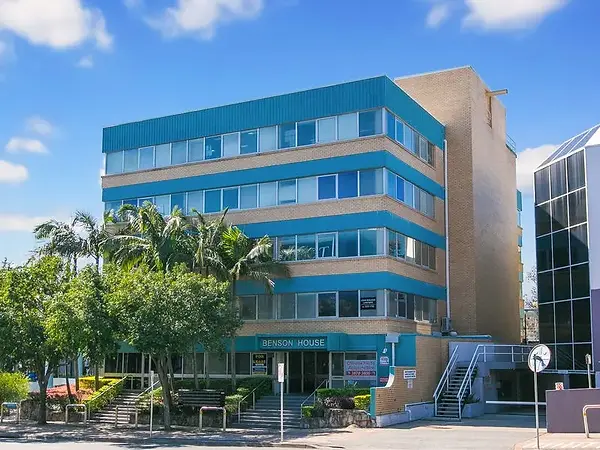
Benson House, 2 Benson Street, Toowong, Queensland, where LOGISOFT Australia operated during the early years of the business.
Continuing in Queensland
Across its various business names and product generations, the company has remained connected to Queensland, Australia, from ANR Computer Services and LOGISOFT Australia through to e-PayDay Pty Ltd.
The office locations changed as the business evolved, but the development of Australian payroll software remained centred in Queensland.
Frequently Asked Questions About e-PayDay's History
When was e-PayDay founded?
The history of e-PayDay can be traced to 22 April 1986, when Allan Reed and Brett Reed established ANR Computer Services in Queensland. Development of PayPacket™, the company's first payroll software product, began in 1986, with the software released in 1987.
The business later became LOGISOFT Australia, and the e-PayDay name was introduced in 2001 as the Logisoft Payroll Series transitioned to e-PayDay.
Who founded e-PayDay?
The business behind e-PayDay was founded by Allan Reed and his son Brett Reed in Queensland in 1986.
What began as ANR Computer Services developed into LOGISOFT Australia and subsequently e-PayDay. The business remains family-owned, with a third generation of the Reed family now involved in the company.
What was LOGISOFT Australia?
LOGISOFT Australia was the predecessor to e-PayDay and developed Australian payroll and other business software.
The LOGISOFT name originated from “LOGIcal SOFTware.” LOGISOFT AUSTRALIA was registered as a Queensland business name on 14 October 1987, while LOGISOFT Australia Pty Ltd was subsequently registered on 17 April 1991.
Its payroll products included PayPacket™, PayBook™ and the Logisoft Payroll Series, which ultimately evolved into e-PayDay.
What was PayPacket™ payroll software?
PayPacket™ was one of LOGISOFT Australia's earliest Australian payroll software products. Development began in 1986 and the software was released for DOS in 1987.
PayPacket™ was designed around Australian payroll requirements and developed with support for Awards, employee pay rates, allowances, deductions, taxation, superannuation, leave and payroll reporting.
Independent computer-magazine coverage from the early 1990s documents PayPacket's extensive payroll functionality and its distinctive Award-based architecture.
When did LOGISOFT payroll software become e-PayDay?
The transition from the Logisoft Payroll Series to the e-PayDay identity occurred in 2001.
The e-PayDay FREEPAY® trade mark was registered in Australia on 5 August 2001, and Logisoft Payroll Series Version 6.00 transitioned to the e-PayDay name on 1 October 2001.
The e-PayDay name has continued through subsequent generations of the company's Windows and cloud payroll software.
How long has e-PayDay provided free payroll software?
Our history of providing free payroll software for small employers dates back to the 1990s, when a free version of the Logisoft payroll software was offered for businesses with small numbers of employees and marketed as Freeware.
The free payroll concept subsequently continued as e-PayDay FREEPAY®.
Today, FREEPAY® continues that history by providing eligible small employers with Australian payroll software without a subscription fee.
What role did e-PayDay play in the development of Single Touch Payroll?
e-PayDay participated in the Australian Taxation Office's Single Touch Payroll co-design, advisory and technical processes during the development and implementation of STP.
Brett Reed represented e-PayDay in STP working groups, including the ATO Single Touch Payroll Advisory Group and technical focus groups, contributing payroll software and technical experience during the development of STP.
e-PayDay subsequently implemented STP reporting in its payroll software ahead of the broader mandatory rollout.
Did e-PayDay lodge the first Single Touch Payroll report processed by the ATO?
Yes. On 6 July 2017, e-PayDay lodged the first Single Touch Payroll report processed by the Australian Taxation Office.
The report used the PAYEVNT.0002.2017 specification and was transmitted through the ATO's Standard Business Reporting (SBR2) infrastructure using an API provided by OZEDI as the Sending Service Provider.
This occurred during the early limited-release implementation of Single Touch Payroll, before STP became mandatory more broadly for Australian employers.
How has e-PayDay supported Australian Modern Awards?
Award-based payroll processing has been part of our software since the PayPacket™ era. Contemporary advertising from 1990 and an independent Your Computer review published in 1994 document PayPacket's Award-related payroll functionality.
That approach continues with e-PayDay Go®, which has supported the Fair Work Commission Modern Awards Pay Database (MAPD) API since the public deployment of Version 0.1.0 (Beta) on 1 December 2022.
The MAPD integration provides access to published data covering Awards, Classifications, Wage-Related Allowances, Expense-Related Allowances and Penalty Rates.
e-PayDay does not automatically determine which Modern Award or classification applies to an employee. Employers remain responsible for determining the appropriate Award and classification.
Is e-PayDay Australian owned and family owned?
Yes. e-PayDay is an Australian family-owned payroll software business whose history began in Queensland in 1986 with Allan Reed and Brett Reed.
The business now spans three generations of the Reed family, with Brett's daughter Sharlyce Reed joining the Payroll Software Support Team in 2009 and subsequently becoming a Business Analyst.
e-PayDay's payroll software continues to be developed around the requirements of Australian employers.
What is e-PayDay Go®?
e-PayDay Go® is e-PayDay's native cloud payroll software platform. The first public Beta, Version 0.1.0, was deployed on 1 December 2022, followed by Version 1 on 17 October 2023.
Developed using ASP.NET Core and C#, e-PayDay Go® migrated the company's payroll software to a cloud-only environment tailored to contemporary Australian payroll requirements, including STP Phase 2 and Fair Work Modern Award data.
It represents the latest generation in the history of payroll software development, which began with PayPacket™ in 1986.
Where can I see historical e-PayDay and LOGISOFT software?
Historical examples of e-PayDay and LOGISOFT software, advertisements, packaging, screenshots and independent magazine coverage are preserved throughout this page.
A working historical version of PayPacket™ for DOS can also be experienced in a modern web browser, providing a first-hand look at an early generation of LOGISOFT Australia's payroll software.