There is no need to stress! e-PayDay Go Award-centric payroll software ensures you effortlessly comply with Payday Super requirements and the Fair Work Voluntary Wage Compliance Code.
Payday Super Australia: Employer Guide and Payroll Software
Payday Super commenced on 1 July 2026, changing how Australian employers calculate, report and pay Superannuation Guarantee (SG) contributions. Employers must now calculate superannuation on Qualifying Earnings (QE) and pay contributions each payday, rather than quarterly.
Under the new legislation, the Superannuation Guarantee rate is 12% of Qualifying Earnings, and contributions must generally be received by the employee's superannuation fund within seven business days after payday, unless an extended timeframe applies.
Employers must also report Qualifying Earnings (QE) and Superannuation Liability (L) through Single Touch Payroll (STP), making accurate payroll configuration, employee information and timely contribution processing essential.
e-PayDay Go® provides an integrated Australian payroll and superannuation solution, combining STP Phase 2 reporting, configurable Pay Types, Qualifying Earnings calculations, superannuation fund validation and SuperStream payment processing to help employers manage their Payday Super obligations.
This guide explains the Payday Super requirements, payment deadlines, Qualifying Earnings calculations and STP reporting obligations, together with how e-PayDay Go® helps employers manage the complete process.
What Is Payday Super and When Did It Start?
Payday Super is an Australian Government reform that commenced on 1 July 2026, requiring employers to pay Superannuation Guarantee (SG) contributions each time they pay their employees, rather than making contributions quarterly.
The reform is designed to reduce unpaid superannuation, improve transparency and ensure employees receive their super contributions sooner, allowing more time for retirement savings to grow.
Under Payday Super, employers must generally calculate SG contributions at 12% of Qualifying Earnings (QE) and ensure the contributions are received by the employee's superannuation fund and capable of allocation to the correct member's account within seven business days after payday, unless an extended timeframe applies.
What Changed on 1 July 2026?
The introduction of Payday Super changed several important employer obligations:
-
Superannuation payments: SG contributions are now required each payday, whether employees are paid weekly, fortnightly or monthly.
-
Qualifying Earnings: SG calculations are based on Qualifying Earnings, which include Ordinary Time Earnings (OTE) and other specified payments.
-
Payment deadlines: SG contributions must generally reach the employee's superannuation fund and be capable of allocation to the correct member's account within seven business days after payday.
-
STP Phase 2 reporting: Employers must report year-to-date Qualifying Earnings (QE) and applicable superannuation liability information through Single Touch Payroll (STP), subject to the ATO's transitional reporting arrangements.
-
Superannuation processing: Employers must use an applicable SuperStream-compliant contribution process, allow sufficient time for contributions to reach the fund, and promptly resolve rejected or returned payments.
These changes make accurate payroll calculations, employee superannuation information and timely contribution processing essential.
Who Must Comply with Payday Super?
Payday Super applies to Australian employers with Superannuation Guarantee obligations, regardless of business size or the number of employees.
This includes employers operating micro, small, medium and large businesses, as well as those engaging workers who are treated as employees for SG purposes.
Certain independent contractors paid principally for their labour may also be entitled to SG contributions under the extended definition of employee.
Employers covered by Fair Work Modern Awards or enterprise agreements must also consider any additional superannuation obligations imposed by those instruments.
Whether a business employs one person or hundreds, Payday Super requires employers to maintain accurate payroll records, calculate their superannuation liabilities and ensure contributions are received within the applicable deadlines.
Payday Super Payment Deadlines and Employer Obligations
Under Payday Super, employers must ensure that Superannuation Guarantee contributions, together with the information required for allocation to the member's account, are received by the employee's superannuation fund within seven business days after payday, unless an extended timeframe applies.
APRA-regulated superannuation funds must generally allocate a contribution to the member's account or return it within three business days, beginning on the first business day after receipt. Different allocation timeframes apply to self-managed superannuation funds (SMSFs).
The employer's payment deadline is based on when the superannuation fund receives the contribution and is able to allocate it to the correct member's account, not when the employer initiates the payment or transfers money to a clearing house. The fund's subsequent allocation process is a separate obligation.
Employers should therefore allow sufficient time for payment processing, superannuation fund validation and the correction of any rejected contributions.
The Seven-Business-Day Payment Rule
Payday Super applies to each payday, regardless of whether employees are paid weekly, fortnightly or monthly.
To meet their obligations, employers should:
-
Calculate SG contributions: Determine the required contribution based on 12% of the employee's Qualifying Earnings (QE), together with any additional applicable superannuation obligations.
-
Process contributions promptly: Arrange payment through a SuperStream-compliant payment method, allowing sufficient time for the contributions to reach the employee's superannuation fund.
-
Validate employee superannuation details: Ensure fund and member information is accurate to reduce the risk of rejected contributions.
-
Monitor contribution processing: Review payment and contribution statuses to identify errors, rejections or returned payments.
-
Resolve errors quickly: Correct invalid information and resubmit affected contributions as soon as possible.
For practical instructions, refer to our e-PayDay Go® Payday Super contribution processing guide.
Important: Paying money to a clearing house does not necessarily mean the contribution has been received by the employee's superannuation fund.
When Does the 20-Business-Day Extension Apply?
Payday Super provides an extended payment timeframe in certain circumstances, including eligible new employees and qualifying changes to an employee's superannuation fund.
Where the relevant conditions are met, employers may have up to 20 business days instead of the standard seven-business-day period for the affected contributions.
These extensions are intended to accommodate additional administrative requirements, such as establishing an employee's superannuation arrangements or processing an eligible change of fund.
The 20-business-day extension is not a general alternative payment deadline. Employers must determine whether the specific circumstances qualify before relying on the additional time.
What Happens When a Superannuation Contribution Is Rejected?
A superannuation fund may reject or return a contribution because of incorrect member details, invalid fund information, account issues or other processing errors.
When this occurs, employers should:
-
Identify the rejection: Review the contribution status and any error message returned by the superannuation fund or payment provider.
-
Correct the information: Update the employee's superannuation details or resolve the identified problem.
-
Resubmit the contribution: Arrange payment to the correct superannuation fund as soon as possible.
-
Maintain accurate records: Retain evidence of the original payment, rejection, correction and successful resubmission.
A rejected or returned contribution does not satisfy the employer's SG obligation merely because the payment reached the superannuation fund. To qualify as an eligible contribution, the payment must be received within the applicable timeframe and be capable of allocation to the correct member's account. Employers should promptly correct and resubmit rejected contributions, recognising that a late resubmission may result in an SG shortfall.
What Happens If Payday Super Is Paid Late?
Employers who fail to pay the correct Superannuation Guarantee contributions by the applicable deadline may become liable for the Superannuation Guarantee Charge (SGC).
Under Payday Super, the SGC framework includes components relating to unpaid superannuation, interest and administration, with additional consequences potentially applying depending on the circumstances.
For the 2026–27 financial year, the Australian Taxation Office (ATO) has adopted a first-year compliance approach that recognises employers making genuine efforts to meet their Payday Super obligations and promptly correct mistakes.
The ATO has indicated that employers genuinely attempting to comply will not be the focus of its compliance activities. However, this approach does not remove the legal obligation to pay SG contributions on time or eliminate any applicable Superannuation Guarantee Charge (SGC) liability.
Employers who identify late, missing or incorrectly directed contributions should correct the problem promptly, maintain appropriate records and follow the ATO's reporting and payment requirements.
What Are Qualifying Earnings (QE) Under Payday Super?
Qualifying Earnings (QE) are the earnings used to calculate Superannuation Guarantee (SG) contributions under Payday Super, which commenced on 1 July 2026.
Employers must generally calculate SG contributions at 12% of Qualifying Earnings each payday, subject to the applicable maximum contributions base and other legislative requirements.
QE includes Ordinary Time Earnings (OTE), together with additional amounts specified under the Payday Super legislation, including commissions, relevant salary sacrifice amounts and payments to eligible non-employees who are treated as employees for Superannuation Guarantee purposes under the extended definition of employee.
Accurately identifying QE is essential for calculating SG contributions and reporting the correct amounts through Single Touch Payroll (STP).
How Do Qualifying Earnings Differ from Ordinary Time Earnings?
Ordinary Time Earnings (OTE) generally include earnings for an employee's ordinary hours of work, such as ordinary wages, applicable allowances, commissions, bonuses and paid leave.
Qualifying Earnings (QE) use Ordinary Time Earnings (OTE) as their foundation and also include other amounts specified under the Payday Super legislation, such as certain payments to workers covered by the extended definition of employee and earnings sacrificed under salary sacrifice arrangements. The legislation preserves the existing treatment of commissions while ensuring that amounts falling within multiple QE categories are counted only once.
This distinction is particularly important for businesses processing salary sacrifice arrangements, commissions, contractor payments and other specialised payroll transactions.
Not every payment made to an employee or eligible non-employee forms part of QE. The correct treatment depends on the characteristics of the payment and the applicable legislation.
Which Payments Are Included in Qualifying Earnings?
Depending on the nature of the payment and the worker's circumstances, Qualifying Earnings can include:
-
Ordinary wages and salaries: Payments for ordinary hours of work, including applicable loadings and over-award payments.
-
Commissions: Commission payments, including amounts that may fall outside ordinary hours of work.
-
Bonuses: Bonuses that qualify as Ordinary Time Earnings under the applicable rules.
-
Allowances: Allowances that qualify as OTE, including certain allowances associated with ordinary working hours.
-
Paid leave: Payments for eligible leave that forms part of OTE.
-
Salary sacrifice amounts: Earnings sacrificed under a salary sacrifice arrangement are included in Qualifying Earnings when required by the legislation. However, salary sacrifice superannuation contributions do not count towards satisfying the employer's compulsory Superannuation Guarantee obligation.
-
Eligible non-employee payments: Payments to individuals treated as employees for SG purposes under the extended definition of employee, including eligible contractors, performers and other covered workers.
Payments that generally do not form part of QE include genuine overtime payments outside ordinary hours, certain expense reimbursements and other payments excluded under the legislation.
Important: The name assigned to a Pay Type does not determine whether a payment is included in QE. Its underlying characteristics and legislative treatment must be considered.

Qualifying Earnings include Ordinary Time Earnings and additional payments specified under Payday Super legislation.
How Can Employers Confirm Which Payments Are Qualifying Earnings?
Determining whether a payment forms part of Qualifying Earnings (QE) is essential when configuring payroll software for Payday Super.
For detailed guidance on the treatment of different earnings and payment types, employers should refer to the Australian Taxation Office's What payments are qualifying earnings? guidance.
Employers must ensure that their payroll Pay Types are correctly configured to calculate Superannuation Guarantee contributions on all applicable remuneration payments. Incorrect classifications can result in underpaid superannuation, reporting errors and potential Superannuation Guarantee Charge liabilities.
Qualifying Earnings for Non-Employees and Contractors
Payday Super also applies to eligible non-employees who are treated as employees for Superannuation Guarantee purposes under the extended definition of employee in superannuation legislation.
These workers may include:
-
Independent contractors: Individuals engaged wholly or principally for their labour who satisfy the applicable SG requirements.
-
Directors and office holders: Individuals receiving remuneration that attracts SG obligations under the relevant statutory provisions.
-
Actors, variety artists and other entertainers: Individuals receiving payments for performances, presentations or other qualifying entertainment activities may be subject to specific PAYG withholding requirements under the ATO's Schedule 3 – Tax Table for Actors, Variety Artists and Other Entertainers. Certain performers and entertainers, including eligible independent contractors, may also be treated as employees for SG purposes under the extended definition of employee.
-
Other eligible workers: Individuals who are not employees under ordinary employment arrangements but are treated as employees for SG purposes, including certain musicians, artists, sportspersons and other individuals undertaking qualifying activities.
For these workers, employers and other entities with SG obligations must identify the payments that constitute Qualifying Earnings (QE) and calculate the applicable superannuation contributions.
Where relevant to determining the SG earnings base, payments for labour must be distinguished from amounts attributable to materials, equipment and GST.
PAYG withholding and Superannuation Guarantee are separate obligations. Employers and other payers must determine the applicable PAYG withholding treatment and independently assess whether the individual is entitled to SG contributions. The application of an entertainer-specific withholding schedule does not, by itself, determine the individual's SG entitlement.
An Australian Business Number (ABN), contractor agreement or invoice does not automatically remove an obligation to pay Superannuation Guarantee. The worker's circumstances and applicable legislative provisions determine whether SG is payable.
Under Payday Super, employers and other entities with SG obligations must generally ensure that contributions for eligible non-employees are received by the relevant superannuation fund and capable of allocation to the correct member's account within seven business days after the applicable Qualifying Earnings payment day, unless an extended timeframe applies. The superannuation fund's subsequent allocation process is a separate obligation.
How e-PayDay Go® Supports Qualifying Earnings Calculations
e-PayDay Go® includes more than 300 configurable Pay Type templates, covering Pay Rates, Allowances, Deductions and Reimbursements.
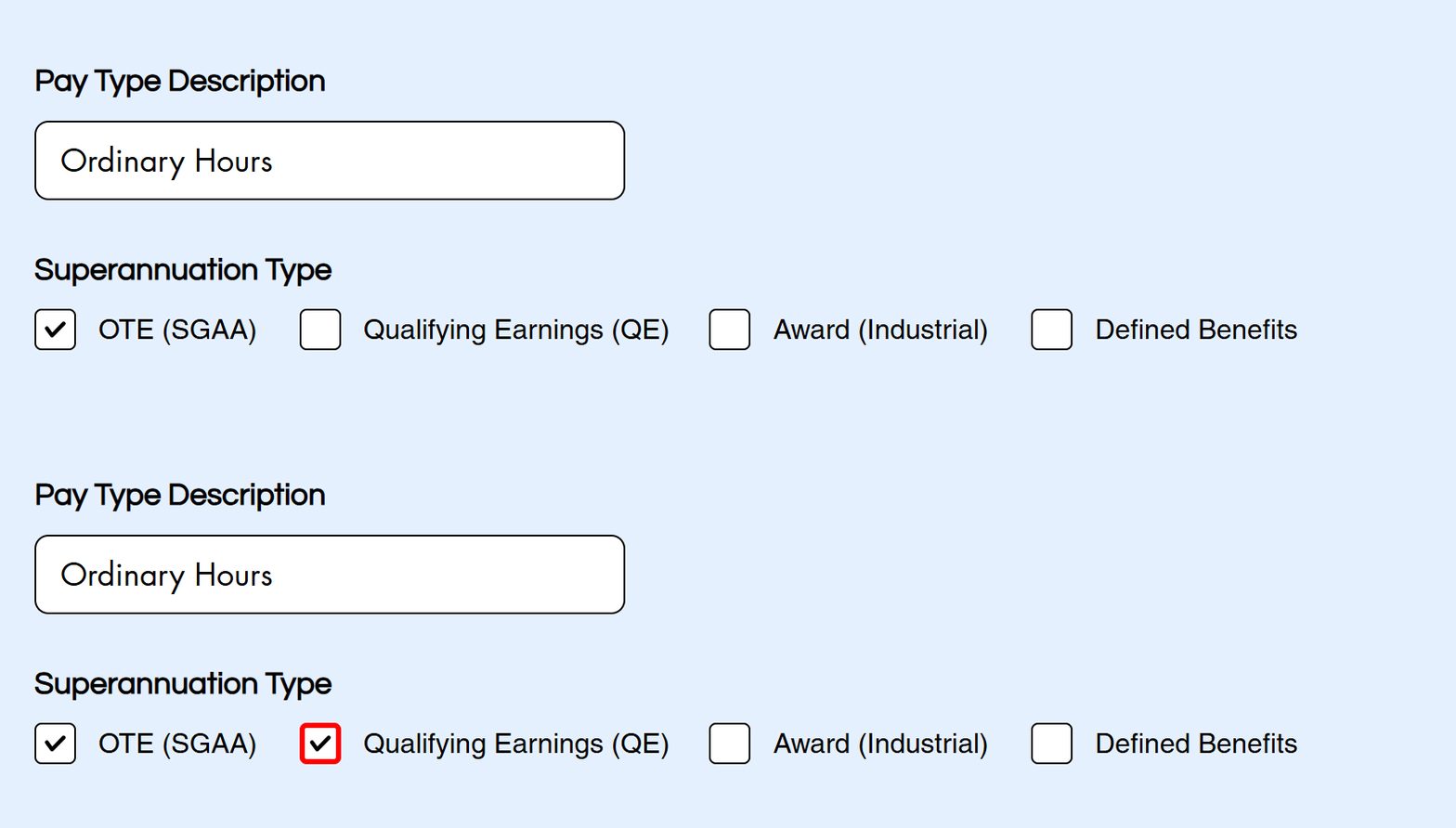
Configurable Pay Types help employers classify earnings correctly for Superannuation Guarantee calculations and STP reporting.
These Pay Types have predefined characteristics that support payroll calculations and ATO reporting requirements, including the treatment of payments relevant to Qualifying Earnings.
Employers can configure Pay Types to reflect their payroll arrangements, helping ensure that earnings are classified correctly for Superannuation Guarantee calculations and STP Phase 2 reporting.
This flexibility is particularly valuable for businesses managing different employee classifications, Modern Awards, enterprise agreements, salary sacrifice arrangements and eligible non-employee payments.
e-PayDay Go® also supports the processing of eligible non-employee and contractor payments, including the recording of Qualifying Earnings and Superannuation Guarantee liabilities, helping businesses manage their associated payroll and STP reporting requirements.
By combining configurable Pay Types with integrated payroll calculations and STP reporting, e-PayDay Go® helps employers manage the complexity of Qualifying Earnings under Payday Super.
How Is Superannuation Guarantee Calculated Under Payday Super?
Under Payday Super, which commenced on 1 July 2026, employers must calculate their statutory Superannuation Guarantee (SG) obligations for each payday using Qualifying Earnings (QE).
The minimum SG rate is 12% of Qualifying Earnings, subject to the applicable maximum contributions base and any special legislative arrangements.
Employers must also consider whether additional superannuation contributions are required under a Modern Award, enterprise agreement, employment contract or Defined Benefit superannuation arrangement.
Correct payroll configuration is essential to ensure that statutory SG liabilities and any additional superannuation obligations are calculated accurately.
Calculating Superannuation Guarantee at 12%
The statutory SG calculation under Payday Super is generally:
Superannuation Guarantee = Qualifying Earnings × 12%
For example, where an employee receives $2,500 in Qualifying Earnings for a fortnightly pay period, the minimum statutory SG contribution is $300.
See how statutory Superannuation Guarantee is calculated using Qualifying Earnings under Payday Super.
Employers must calculate SG for each payday and arrange payment so that contributions are generally received by the employee's superannuation fund within seven business days after payday, unless an extended timeframe applies.
The superannuation fund is then responsible for allocating the contribution to the member's account within its applicable processing timeframe.
Important: The SG calculation must use the correct statutory Qualifying Earnings amount, rather than automatically applying 12% to every payment made through payroll.
Salary sacrifice: Earnings sacrificed into superannuation remain part of the applicable Qualifying Earnings base. However, salary sacrifice superannuation contributions cannot be used to reduce the employer's separate compulsory SG contribution obligation.
How Does the Maximum Contributions Base Apply?
The Maximum Contributions Base (MCB) limits the earnings on which an employer is required to calculate minimum statutory Superannuation Guarantee contributions.
From 1 July 2026, Payday Super changed the MCB from a quarterly limit to an annual limit.
For the 2026–27 financial year, the annual Maximum Contributions Base is $270,830.
The annual MCB is calculated using the concessional contributions cap and the applicable SG charge percentage, rounded down to the nearest $10.
Each employer must generally calculate statutory SG on the Qualifying Earnings they pay to an employee during the financial year until the applicable annual Maximum Contributions Base is reached for that employer. Special rules, including employer shortfall exemption certificates, may apply in qualifying circumstances.
Where a pay run takes an employee's cumulative QE above the annual MCB, statutory SG is generally required only on the remaining earnings up to that limit.
Example: An employee has already received $268,000 in Qualifying Earnings during the financial year and is paid another $5,000.
Only $2,830 remains below the annual MCB. The minimum SG contribution for that payday is therefore:
$2,830 × 12% = $339.60
Once the employee reaches the annual Maximum Contributions Base, further statutory SG contributions are generally not required for that financial year. However, additional contributions may still be required under an applicable Award, Agreement, contract or other arrangement.
Additional Superannuation Under Modern Awards and Enterprise Agreements
The Superannuation Guarantee (Administration) Act 1992 (SGAA) establishes the minimum statutory Superannuation Guarantee obligations. However, employers may have additional superannuation obligations under an applicable Modern Award, enterprise agreement, employment contract or other industrial instrument.
These arrangements may require contributions calculated using a broader earnings base, a higher contribution rate or additional payment types that do not form part of statutory Qualifying Earnings.
For example, an applicable industrial instrument may require superannuation contributions on certain payments that would otherwise be excluded from the statutory SG calculation.
Employers must identify and correctly configure these additional obligations separately from the minimum statutory SG requirements.
Not all payments attracting superannuation are necessarily Qualifying Earnings under the SGAA. For Single Touch Payroll reporting, employers must distinguish the legislated QE amount from additional earnings that attract superannuation under other arrangements.
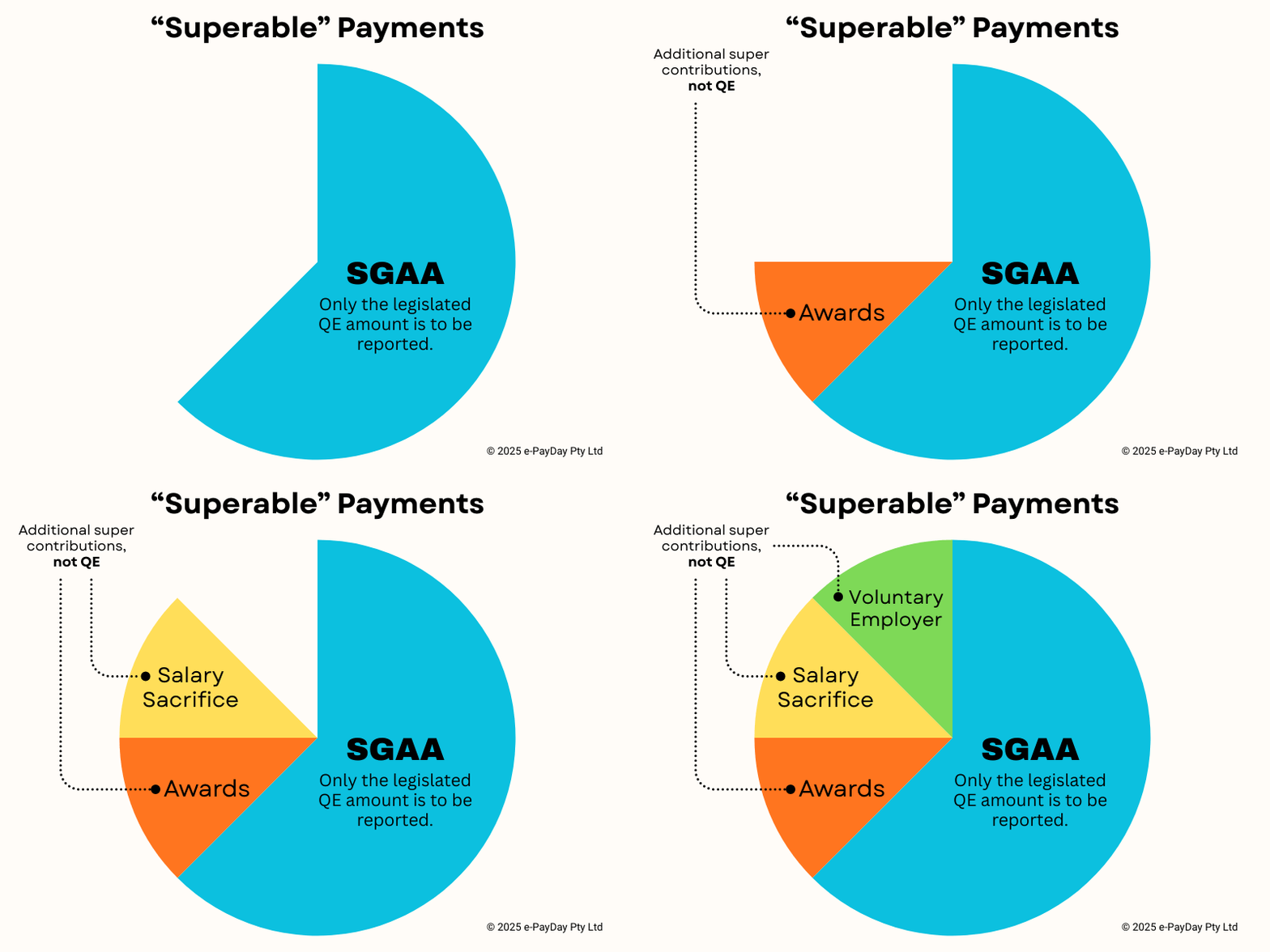
Only legislated Qualifying Earnings are reported as QE through Single Touch Payroll, even where additional payments attract superannuation under other arrangements.
Similarly, additional employer contributions must be classified according to their characteristics and the applicable ATO reporting requirements. Not every contribution above the statutory minimum is automatically a Reportable Employer Superannuation Contribution (RESC).
This distinction is important for businesses processing payroll under multiple Modern Awards, enterprise agreements or individual employment arrangements.
How Do Defined Benefit Superannuation Schemes Affect SG Calculations?
Some employees are members of Defined Benefit superannuation schemes, where employer contribution obligations may be determined under special rules rather than solely by applying the standard SG percentage to Qualifying Earnings.
Where an applicable Benefit Certificate is in place, the certified notional employer contribution rate and the relevant scheme arrangements must be considered when determining the employer's statutory SG position.
The earnings base used to calculate actual contributions may also be defined by the fund's governing rules or applicable employment arrangements.
Employers should confirm the relevant requirements with the Defined Benefit fund or scheme administrator and ensure their payroll software is configured accordingly.
Defined Benefit arrangements require separate consideration and should not automatically be treated in the same way as ordinary accumulation fund contributions.
How e-PayDay Go® Supports Superannuation Calculations
e-PayDay Go® provides configurable payroll functionality to support statutory Superannuation Guarantee calculations and additional superannuation obligations.
With more than 300 configurable Pay Type templates, employers can define the characteristics of payments used in payroll calculations, including Pay Rates, Allowances, Deductions and Reimbursements.
These capabilities help businesses:
-
Calculate statutory SG liabilities: Apply the relevant Superannuation Guarantee rules to correctly classified Qualifying Earnings.
-
Configure additional superannuation obligations: Support contribution arrangements arising under Modern Awards, enterprise agreements and other employment conditions.
-
Manage salary sacrifice arrangements: Record and distinguish applicable salary sacrifice contributions from statutory SG obligations.
-
Process eligible non-employee payments: Support the payroll treatment of contractors and other workers who are treated as employees for SG purposes.
-
Maintain superannuation records: Record contributions and liabilities to support payroll reconciliation and reporting.
-
Support STP Phase 2 reporting: Report statutory Qualifying Earnings and Superannuation Liability using the applicable ATO reporting requirements.
Employers remain responsible for ensuring their payroll configuration reflects the correct legislation, applicable industrial instruments and individual employment arrangements.
By combining configurable Pay Types with integrated payroll processing and STP reporting, e-PayDay Go® helps businesses manage both statutory and additional superannuation obligations under Payday Super.
How Is Payday Super Reported Through Single Touch Payroll (STP)?
Payday Super introduced changes to Single Touch Payroll (STP) reporting from 1 July 2026, including the reporting of Qualifying Earnings (QE) alongside Superannuation Liability.
Under STP Phase 2, employers report payroll information to the Australian Taxation Office (ATO), including salaries and wages, PAYG withholding, superannuation liabilities and other applicable employee information.
The Payday Super changes help the ATO identify the earnings used to calculate statutory Superannuation Guarantee (SG) obligations and compare reported liabilities with superannuation contributions.
Employers should report year-to-date Qualifying Earnings and Superannuation Liability for each applicable worker, using payroll software configured for the updated STP requirements.
What Are the Q, L and R Superannuation Reporting Codes?
The STP Phase 2 Superannuation Entitlement reporting structure identifies different superannuation amounts using specific reporting codes:
-
Q — Qualifying Earnings: The legislated earnings amount used to determine statutory Superannuation Guarantee obligations under Payday Super.
-
L — Superannuation Liability: The employer's reportable superannuation liability calculated in accordance with the applicable STP reporting rules.
-
R — Reportable Employer Superannuation Contributions (RESC): Additional employer superannuation contributions that meet the ATO's RESC reporting criteria.
Qualifying Earnings and Superannuation Liability are separate reporting amounts. QE identifies the relevant earnings base, while the Superannuation Liability identifies the reportable superannuation amount.
RESC must also be distinguished from statutory SG contributions. Additional contributions are not automatically classified as RESC merely because they exceed the minimum SG amount.
Correct classification is essential to ensure that the ATO receives accurate superannuation information.

Payday Super STP reporting identifies Qualifying Earnings, Superannuation Liability and RESC using separate Super Entitlement reporting codes.
How Are Qualifying Earnings and Superannuation Liability Reported?
Under Payday Super, payroll software must support the reporting of year-to-date Qualifying Earnings (Q) and year-to-date Superannuation Liability (L) through STP.
For each relevant worker, the employer must correctly identify the earnings subject to statutory SG and calculate the corresponding liability.
For example, where an employee receives $2,500 in Qualifying Earnings and the applicable SG rate is 12%, the minimum statutory SG calculation is $300, subject to the relevant legislative rules.
The payroll software must maintain the appropriate year-to-date balances and report them using the relevant STP data elements.
STP reporting does not constitute payment of superannuation contributions. Employers must separately arrange payment through an applicable SuperStream-compliant process and generally ensure that contributions are received by the employee's superannuation fund and capable of allocation to the correct member's account within seven business days after the relevant payday, unless an extended timeframe applies.
Reporting a Superannuation Liability through STP does not, by itself, establish that an eligible SG contribution has been received within the statutory deadline.
When Must Employers Start Reporting Qualifying Earnings?
Payday Super commenced on 1 July 2026, introducing a legislative requirement to report Qualifying Earnings (QE) through Single Touch Payroll (STP).
The ATO introduced updated STP reporting arrangements to support Payday Super, including the reporting of year-to-date Qualifying Earnings (Q) and Superannuation Liability (L). Employers must follow the applicable ATO reporting specifications and transitional arrangements for the 2026–27 financial year.
However, transitional arrangements apply during the 2026–27 financial year.
Employers who cannot report the new QE information immediately should commence reporting it as soon as their payroll software and processes allow. The ATO has advised that employers commencing QE reporting during 2026–27 do not need to request a reporting deferral solely for that reason.
The transitional reporting arrangements do not remove the employer's obligation to calculate and pay the correct Superannuation Guarantee contributions.
Employers should follow the ATO's current guidance and their payroll software provider's instructions to ensure they meet the applicable reporting requirements.
How Are Reportable Employer Superannuation Contributions (RESC) Treated?
Reportable Employer Superannuation Contributions (RESC) are employer superannuation contributions that meet the ATO's reporting criteria, generally involving additional contributions over which the employee has influence.
Examples may include certain salary sacrifice contributions and additional employer contributions made under arrangements influenced by the employee.
Not all contributions above the statutory SG minimum are RESC. Contributions required under an applicable industrial instrument or other employment arrangement may have a different reporting treatment.
Employers must therefore distinguish:
-
Statutory SG contributions: Contributions required to satisfy minimum Superannuation Guarantee obligations.
-
Additional compulsory contributions: Contributions required under an Award, Agreement or other applicable arrangement.
-
Reportable Employer Superannuation Contributions: Contributions that satisfy the ATO's specific RESC criteria.
Accurate classification helps prevent incorrect STP reporting and ensures that superannuation amounts are reported according to their legislative characteristics.
How e-PayDay Go® Supports Payday Super STP Reporting
e-PayDay Go® supports STP Phase 2 reporting and the Payday Super reporting requirements for Qualifying Earnings and Superannuation Liability.
Its configurable Pay Types help employers classify payroll payments according to their characteristics and determine the relevant superannuation reporting treatment.
e-PayDay Go® supports:
-
Qualifying Earnings reporting: Recording and reporting the applicable QE amounts through STP.
-
Superannuation Liability reporting: Maintaining and reporting superannuation liabilities using the relevant STP reporting codes.
-
RESC reporting: Identifying and reporting applicable additional employer contributions.
-
Salary sacrifice arrangements: Recording concessional and non-concessional contributions with the appropriate payroll and reporting treatment.
-
Eligible non-employee reporting: Supporting relevant contractor and other extended-definition employee payments.
-
Payroll adjustments: Allowing authorised adjustments to relevant QE, SG and RESC amounts where required.
-
STP Phase 2 lodgement: Submitting the required payroll information to the ATO through the established STP reporting process.
By integrating configurable payroll calculations with STP reporting, e-PayDay Go® helps employers manage the additional reporting requirements introduced by Payday Super.
Employers remain responsible for ensuring their Pay Types, employee arrangements and superannuation classifications are correctly configured.
How Does e-PayDay Go® Process Payday Super Payments?
e-PayDay Go® integrates payroll processing, Superannuation Guarantee calculations, STP reporting and SuperStream contribution processing, helping Australian employers manage their Payday Super obligations from within their payroll workflow.
Through its integration with SuperChoice, a superannuation clearing house service, e-PayDay Go® enables employers to prepare and process superannuation contributions without having to manually recreate payroll contribution information in a separate system.
Once a pay run has been completed, employers can access the Process Super Payment function from the Pay Day Actions menu.
This provides a straightforward way to initiate superannuation contribution processing while maintaining the information needed to monitor payment progress and resolve errors.
How Do I Process Payday Super Payments in e-PayDay Go®?
The process follows the normal payroll workflow:
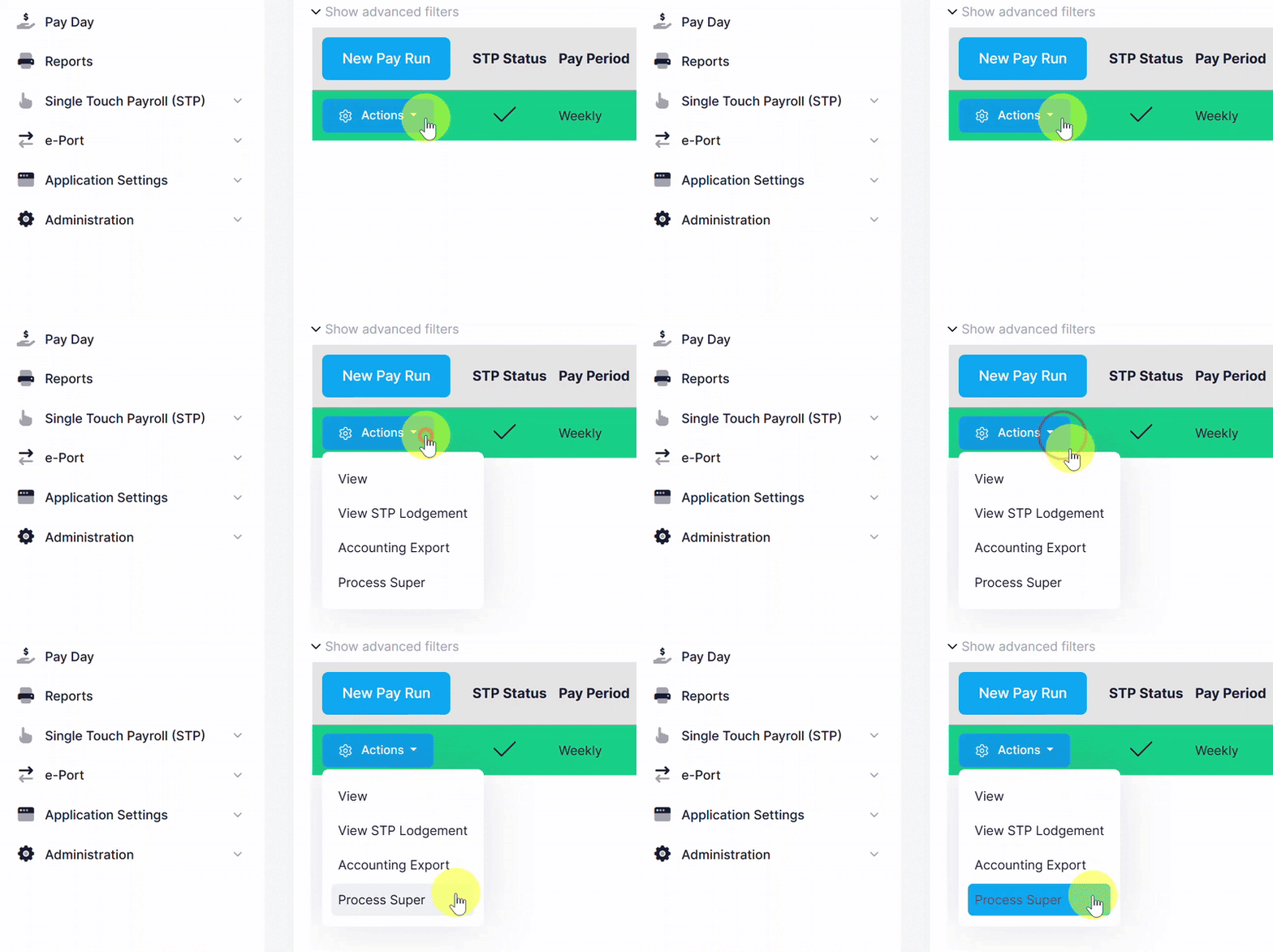
Process Payday Super contributions directly from the e-PayDay Go® Pay Day Actions menu using the integrated SuperChoice clearing house service.
-
Complete the pay run: Process employee earnings, calculate applicable Qualifying Earnings (QE), and determine statutory SG and other superannuation contributions.
-
Review superannuation liabilities: Check contribution amounts, employee fund details and any applicable salary sacrifice or additional employer contributions.
-
Lodge the STP report: Submit the pay run's applicable payroll and superannuation liability information to the Australian Taxation Office.
-
Select Process Super: Open the Pay Day Actions menu and select Process Super.
-
Complete the contribution submission: Follow the payment workflow to prepare and submit the relevant contribution information and arrange payment through the integrated SuperChoice service.
-
Monitor the contribution status: Review available SuperChoice processing information, identify rejected or returned contributions, and take corrective action where required. A successful submission does not, by itself, establish that the contribution has reached the superannuation fund.
For detailed instructions, see our e-PayDay Go® SuperChoice contribution processing guide.
How Does SuperChoice Support SuperStream Payments?
SuperChoice provides the clearing house integration used by e-PayDay Go® to support electronic superannuation contribution processing.
The integration helps employers manage the contribution information generated by payroll and submit payments through a SuperStream-compliant process.
SuperStream standardises the electronic transmission of contribution data and payments between employers, intermediaries and superannuation funds.
By using the integrated payroll and clearing house workflow, employers can reduce the need to re-enter contribution information and improve consistency between payroll records and submitted superannuation contributions.
The employer remains responsible for ensuring contributions are paid correctly and within the applicable deadline, even when a clearing house or other payment intermediary is used.
When Are Payday Super Contributions Considered Paid?
Under Payday Super, employers must generally ensure that Superannuation Guarantee (SG) contributions are received by the employee's superannuation fund and capable of allocation to the correct member's account within seven business days after payday, unless an extended timeframe applies.
The employer's obligation is not determined by when the fund actually completes the allocation. If the contribution is received on time with the information necessary for allocation, a subsequent delay by the fund in allocating the contribution does not, by itself, mean the employer has failed to meet the payment deadline.
The superannuation fund must then allocate the contribution to the member's account within its applicable processing timeframe or return it if allocation cannot be completed.
There is an important difference between:
-
Calculating the contribution: Determining the superannuation amount payable from payroll.
-
Submitting the contribution: Initiating the contribution and payment through the clearing house.
-
Fund receipt: The contribution and required information reaching the employee's superannuation fund.
-
Member allocation: The superannuation fund allocating the contribution to the relevant member's account.
Employers should not assume that submitting a payment through a clearing house means the contribution has already reached the employee's superannuation fund.
Successful contribution processing requires accurate payment information, correct fund and member details, and appropriate monitoring of the contribution outcome.
What Happens if a Superannuation Payment Is Rejected?
Superannuation contributions may be rejected or returned because of incorrect employee information, invalid fund details, account problems or other processing errors.
Where a contribution is unsuccessful, employers should:
-
Review the error: Identify the reason the contribution was rejected or returned.
-
Correct the information: Update the affected fund, member or contribution details.
-
Resubmit the contribution: Arrange a corrected payment as soon as possible.
-
Check the deadline: Determine whether the contribution can still reach the correct superannuation fund within the applicable timeframe.
-
Maintain accurate records: Retain information about the original submission, error, correction and subsequent processing outcome.
A contribution that is rejected or returned because it cannot be allocated to the intended member's account does not qualify as an eligible SG contribution merely because it reached the fund. Employers must correct the problem and arrange a valid contribution, recognising that a payment received after the applicable deadline may result in an SG shortfall.
The ATO's transitional compliance approach for 2026–27 recognises employers making genuine efforts to comply, but it does not remove the obligation to pay the correct superannuation amounts.
Employers should therefore resolve errors promptly rather than waiting until the payment deadline has passed.
Why Use Integrated Payroll and Superannuation Processing?
Integrated payroll and superannuation processing helps employers manage the relationship between payroll calculations, STP reporting and contribution payments.
With e-PayDay Go®, employers can use the information generated during payroll processing to support their superannuation contribution workflow.
This approach offers practical benefits:
-
Reduced manual administration: Contribution information is generated from payroll records rather than recreated independently.
-
Consistent payroll information: Superannuation calculations and contribution processing are based on the relevant payroll data.
-
Support for different contribution types: Employers can manage statutory SG alongside applicable salary sacrifice and additional superannuation contributions.
-
SuperStream-compliant processing: Electronic contribution data and payments are managed through the integrated clearing house service.
-
Improved payment oversight: Employers can review available contribution processing information and investigate unsuccessful transactions.
e-PayDay Go® helps employers move from payroll processing to superannuation contribution submission through an integrated workflow, while retaining responsibility for the accuracy and timeliness of their payments.
How Does Payday Super Affect Employer Cash Flow and Superannuation Contributions?
Payday Super changes how Australian employers manage superannuation cash flow by requiring Superannuation Guarantee (SG) contributions to be paid in connection with each payday rather than quarterly.
Since 1 July 2026, employers have generally been required to ensure SG contributions are received by employees' superannuation funds and capable of allocation to the correct member accounts within seven business days after payday, unless an applicable extended deadline applies.
This means businesses paying employees weekly, fortnightly or monthly must plan for superannuation payments at the same frequency.
e-PayDay Go® helps employers calculate superannuation liabilities during payroll processing and prepare the corresponding contributions for payment through its integrated SuperChoice clearing house service.
How Should Employers Manage Cash Flow Under Payday Super?
Previously, employers could generally accumulate statutory SG liabilities and pay them quarterly. Under Payday Super, employers need to make the corresponding funds available much sooner.
For example, an employer processing fortnightly payroll must now plan for SG contributions associated with each fortnightly payday rather than retaining those amounts until the end of the quarter.
Employers should:
-
Budget for superannuation every payday: Include SG liabilities when forecasting wages and other payroll expenses.
-
Review available funds: Ensure sufficient money is available to meet both employee payments and associated superannuation contributions.
-
Allow for processing time: Consider banking cut-off times, clearing house processing and potential contribution rejections.
-
Check contribution information: Maintain accurate employee, superannuation fund and membership details.
-
Monitor payment outcomes: Identify unsuccessful contributions promptly and arrange corrections before the applicable deadline.
Payday Super does not introduce a higher statutory SG percentage. The SG rate remains 12%, but the payment frequency and calculation framework have changed.
What Are Holding Accounts in e-PayDay Go®?
Holding Accounts provide a way to organise and manage superannuation-related amounts within the payroll and contribution processing workflow.
The Holding Accounts screen in e-PayDay Go® provides employers with information relevant to managing these amounts.
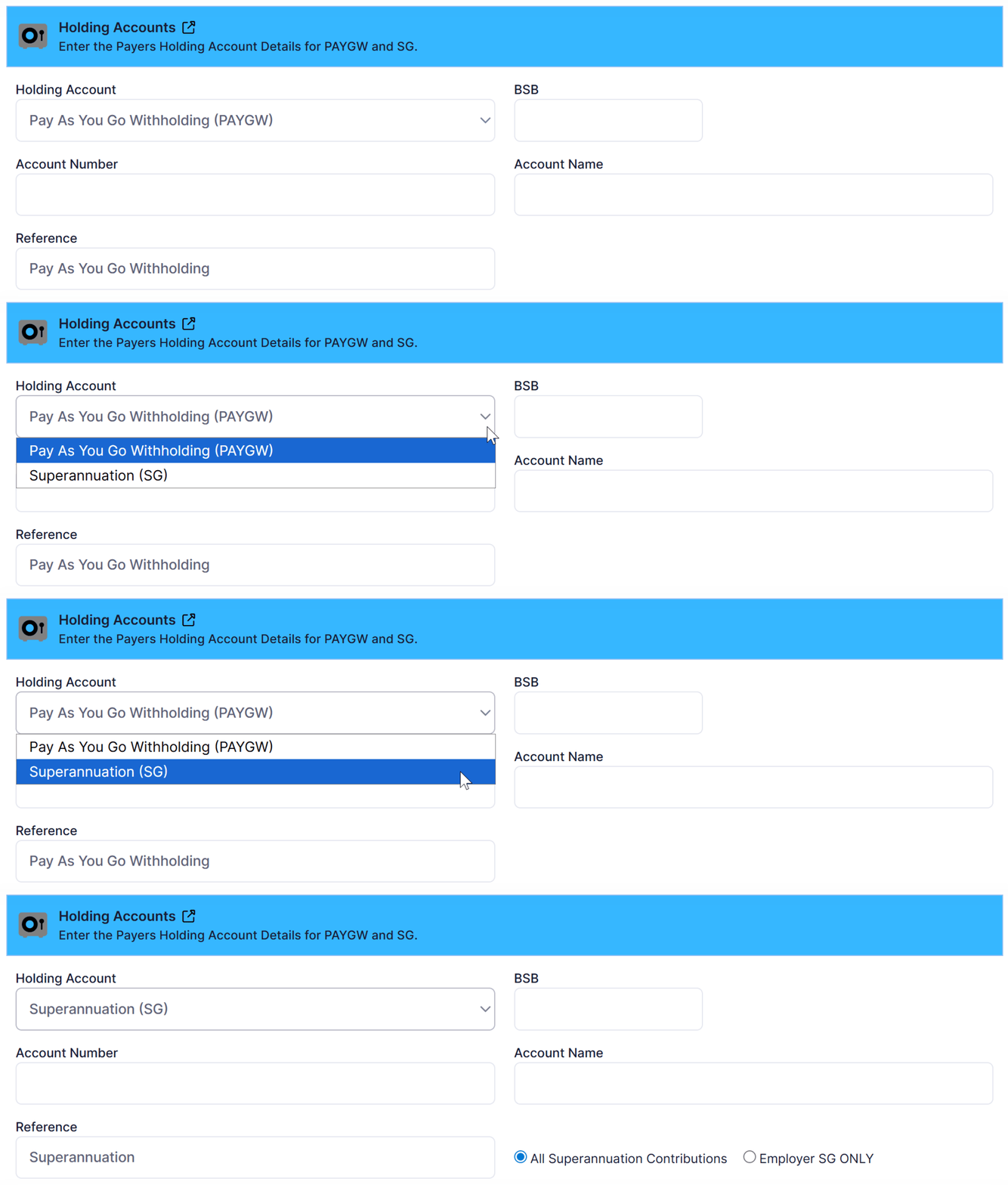
The e-PayDay Go® Holding Accounts screen supports the administration of superannuation-related amounts within the payroll workflow.
It is important to distinguish between recording or holding an amount within a payroll-related workflow and completing a contribution payment to the employee's superannuation fund.
An amount recorded in a Holding Account is not, by itself, evidence that the employer has satisfied the Payday Super payment deadline.
Employers must ensure the required contribution and accompanying information reach the correct superannuation fund within the applicable statutory timeframe.
What Types of Superannuation Contributions Must Employers Manage?
Employers may need to process different types of superannuation contributions, each with its own calculation, reporting and payment treatment.
These include:
-
Superannuation Guarantee (SG): Statutory employer contributions calculated under the SG legislation, generally at 12% of Qualifying Earnings, subject to applicable rules.
-
Additional employer contributions: Contributions required under a Modern Award, Enterprise Agreement, employment contract or other applicable arrangement.
-
Salary sacrifice contributions: Contributions made under an effective salary sacrifice arrangement, which require the appropriate payroll and tax reporting treatment.
-
Reportable Employer Superannuation Contributions (RESC): An ATO reporting classification for certain employer superannuation contributions, rather than a separate payment category in every case. Contributions meeting the RESC criteria must be reported separately through STP where applicable.
-
Personal employee contributions: Contributions made from an employee's after-tax income, which must be distinguished from employer SG liabilities.
Salary sacrifice superannuation contributions do not count towards satisfying an employer's compulsory SG obligation, even though the earnings sacrificed may form part of Qualifying Earnings.
Not every superannuation contribution has the same legal payment deadline or STP reporting treatment.
Employers must identify the relevant contribution type and apply the applicable superannuation requirements under Modern Awards and Enterprise Agreements, together with any other legislative or contractual obligations.
When Are Superannuation Contributions Due Under Payday Super?
For statutory SG contributions, employers must generally ensure that the employee's superannuation fund receives the contribution and is capable of allocating it to the correct member's account within seven business days after the relevant Qualifying Earnings payment day.
Specific extended timeframes may apply, including:
-
New employees or a change of superannuation fund: An extended period of up to 20 business days applies to qualifying first contributions for a new employee or the first contribution to a different fund for an existing employee.
-
Certain out-of-cycle payments: Where the ATO Commissioner has designated a payment type and the applicable conditions are satisfied, the contribution deadline may extend to the usual payment deadline following the employee's next regular Qualifying Earnings payment.
-
Exceptional circumstances: A different deadline may apply where the employer and relevant Qualifying Earnings payment day are covered by an applicable ATO Commissioner determination.
Where an extended deadline applies, a statutory bunching rule may also align the deadlines for certain subsequent paydays so that later contributions are not due before the earlier contribution covered by the extension.

Different superannuation contribution types may have different payment deadlines. Employers must distinguish statutory SG obligations from additional contributions required under other arrangements.
These extensions do not automatically override earlier payment obligations arising under applicable legislation, fund rules or industrial instruments.
Employers should not assume that the statutory SG deadline also governs every additional employer, salary sacrifice or employee contribution.
The correct deadline depends on the contribution's legal and contractual characteristics.
How Does e-PayDay Go® Help Employers Manage Different Contribution Types?
e-PayDay Go® supports the recording and processing of different superannuation contribution types, including statutory SG, applicable additional employer contributions, salary sacrifice arrangements and employee contributions.
Its configurable Pay Types help employers distinguish between payments that form part of statutory Qualifying Earnings and amounts that may attract superannuation under other arrangements.
The integration between payroll calculations, STP reporting and SuperChoice contribution processing helps employers maintain consistent contribution information.
Employers remain responsible for correctly configuring their payroll arrangements, reviewing contribution amounts and ensuring payments are completed within the applicable deadlines.
By managing superannuation alongside payroll, e-PayDay Go® helps employers plan their cash flow and administer the more frequent payment requirements introduced by Payday Super.
How Can Employers Track Payday Super Contributions and Payment Status?
e-PayDay Go® provides integrated tools to help Australian employers monitor superannuation contribution processing and identify payments that may require attention.
The Payday Super Status Payroll Tools Dashboard Widget, displayed on the payroll dashboard, provides a visual overview of the available processing status information for recent superannuation contributions.
Employers can use this information to monitor contribution processing, investigate unsuccessful payments and take corrective action where necessary.
A successful contribution submission does not, by itself, confirm that the payment has reached the employee's superannuation fund or satisfied the statutory Payday Super deadline.

What is Single Touch ePayDay Super®?
Single Touch ePayDay Super® is a suite of integrated superannuation management features within e-PayDay Go®, designed to help Australian employers calculate, validate, process and monitor superannuation contributions.
Supporting the Payday Super requirements introduced on 1 July 2026, these features connect payroll calculations, superannuation contribution information and payment processing through the integrated SuperChoice clearing house service.
By bringing superannuation administration into the payroll workflow, Single Touch ePayDay Super® helps employers identify contribution errors, monitor available processing information and manage their Superannuation Guarantee obligations more efficiently.
Key capabilities include:
-
Superannuation validation tools to help identify incorrect or incomplete employee fund and contribution information before processing
-
Integrated payroll and SuperChoice workflows for preparing and submitting superannuation contributions
-
Payday Super Status Widget providing visibility of available contribution processing information
-
Contribution monitoring tools to help identify rejected or returned contributions requiring corrective action
-
Superannuation Guarantee compliance support to assist employers in meeting statutory payment obligations and reducing the risk of Superannuation Guarantee Charge (SGC) liabilities
Single Touch ePayDay Super® provides employers with greater visibility and control over their superannuation contribution processes, helping them manage accurate payments, identify processing issues and meet the more frequent contribution requirements introduced by Payday Super.
Employers remain responsible for ensuring statutory SG contributions are received by the relevant superannuation fund and capable of allocation to the correct member's account within the applicable deadline.
How Can Employees Track Their Superannuation Contributions with ClockMeIn®?
ClockMeIn® Payrollee Self Service, integrated with e-PayDay Go®, helps employees conveniently monitor their payroll and superannuation information from their mobile devices.
Employees receive notifications through ClockMeIn® when their superannuation contributions have been processed. They can also check their year-to-date (YTD) payroll balances, access their payslips and review their digital timesheets.
Superannuation processing notifications should not be confused with confirmation that contributions have been received and allocated by the employee's superannuation fund. Employees can verify contributions credited to their superannuation accounts through their fund's member portal or mobile app.
What Payroll and Superannuation Information Can Employees Access?
-
Payslip and superannuation notifications: Receive notifications about payslips and processed superannuation contributions.
-
Year-to-date payroll balances: Conveniently review YTD payroll information.
-
Digital timesheets: Access recorded timesheet information when needed.
-
Payslip access: View and download payslips directly from ClockMeIn®.
